Xing Ziqiang | The three factors suppressing U.S. inflation are reversing
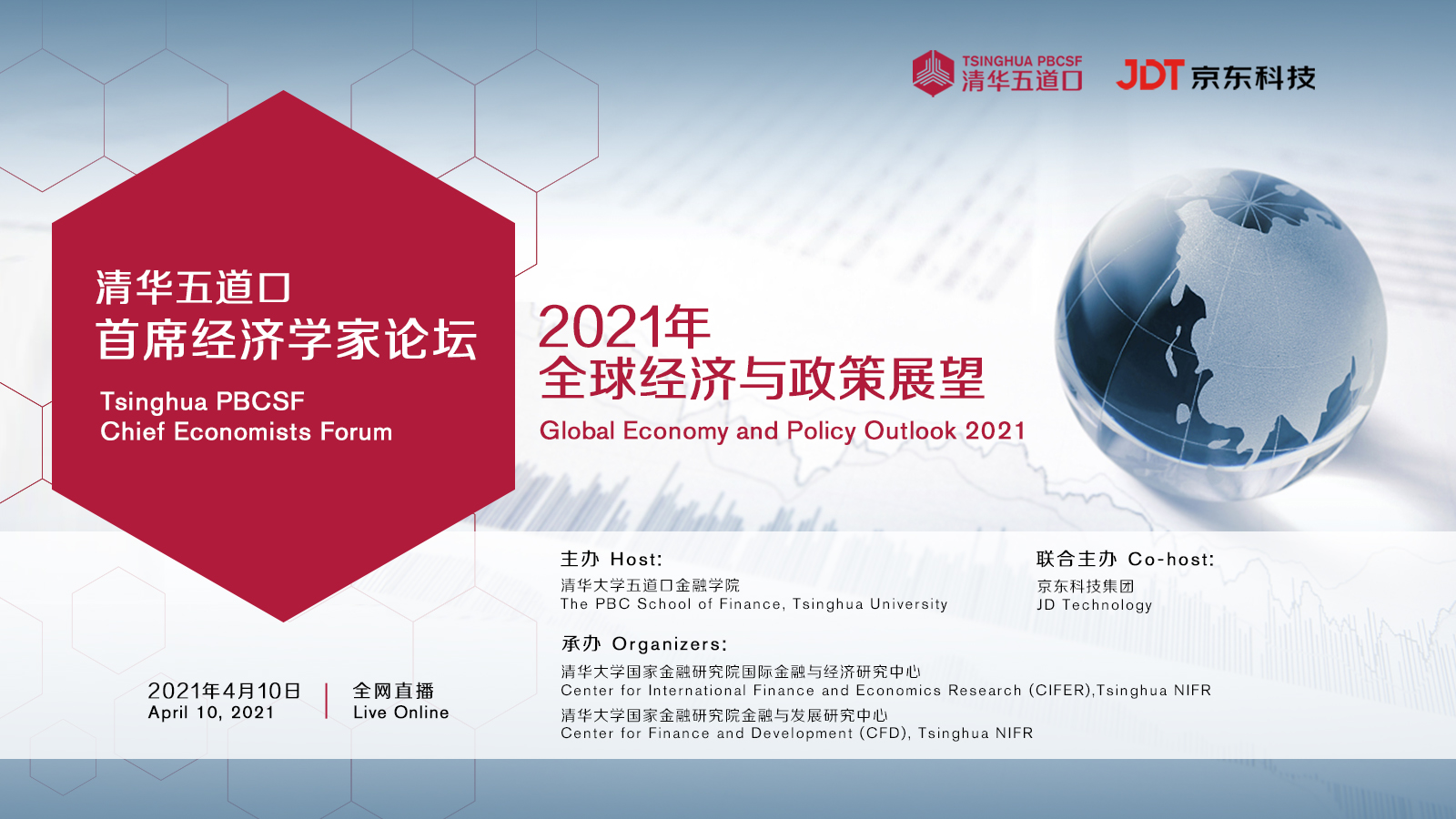
Recently, a conference was held, hosted by Tsinghua University's PBCSF (Public School of Finance), co-hosted by JD.com, and organized by the Center for International Finance and Economics Research (CIFER) and the Center for Financial and Development Research (CFD) of Tsinghua University's National Institute of Financial Research. “Tsinghua University PBC School of Finance Chief Economist Forum – 2021 Global Economic and Policy OutlookThe event was broadcast live on 27 platforms across the internet, attracting attention from nearly 100 media outlets and drawing over 10 million viewers.Professor Ju Jiandong, Ziguang Chair Professor of Tsinghua University's PBC School of Finance and Director of the Center for International Economics and Finance Research (CIFER), served as the forum's chief moderator.

The moderator for the first roundtable discussion was Shen Jianguang, chief economist of JD Technology Group.Chief economists aroundGlobal Economic OutlookThis topic was discussed in depth, with the consensus being that the global economic recovery in 2021 will be divergent, and the upside risks to the US economy are high. However, the chief analysts held differing views on whether there will be sustained inflationary pressures and the spillover effects of rising US Treasury yields on international financial markets.

Xing Ziqiang
Morgan Stanley's Chief Economist for China, Xing Ziqiang, mentioned in his speechThe global economy is currently facing unprecedented changes in the past 30 years, and the current inflationary pressures in the United States are extraordinary. The "high-pressure economy" being built by the US aims to promote full employment for the middle class and blue-collar workers, not only pursuing GDP growth back to pre-pandemic levels but also ensuring benefits for low- and middle-income groups. However, an unavoidable side effect is inflation. If the US economy overheats, inflation could very well reach above 2.5% by the end of this year or early next year. Furthermore, three structural factors make the pressure for a resurgence of US inflation in the medium to long term considerable, as the three factors that have suppressed inflation and increased productivity over the past 30 years are now reversing: Trade (the reversal of trade globalization), Tech (the reversal of tech giantization), and Titans (the reversal of income distribution favoring corporatism). Faced with the US economic policy shift to the left and the entry into a high-pressure economic environment, China's 14th Five-Year Plan strategic measures focus on improving productivity and preventing economic involution.
 Xing Ziqiang's speech
The following is the full text of the speech, which has not been reviewed by the speaker:
Xing Ziqiang: Thank you, I'm very happy to have the opportunity to participate in this discussion today.
As the speakers have already explained, the global economic environment China faces this year is vastly different from last year. Last year, China was largely the sole standout, with the key phrase being "pandemic economics"—effective pandemic control translates into productivity. However, this year, developed Western economies, especially the United States, are poised for a strong comeback, and the key global economic theme has shifted to the "Biden new cycle" in the US. I agree; there's not much controversy about it. Last year, China's outstanding performance was like a flower blooming even when the global economy was on a precipice. This year, China's policies have been among the first to return to normalcy, showing its strength without vying for attention. However, I want to emphasize that the global economy may be facing a major shift unseen in 30 years. This could lead to a new wave of inflationary pressures that are not just...It's not short-term cyclical inflation caused by an overheated US economy, but rather long-term structural inflationary pressure. Behind this, we can see the spillover effects of Biden's new high-pressure economics on the world and on China. How should China respond? I think the approach might be slightly different.
Will Biden's high-pressure economics lead to a resurgence of inflation? A two-pronged approach is needed, and both must be strong. As the name suggests, high-pressure economics continues the frictional, high-pressure competitive conflict with China in trade and economic relations, particularly in high-tech, security, and even monetary fields, leading to long-term competition and maneuvering. The industrial chain will place greater emphasis on self-sufficiency and the return of industries to domestic markets. Domestically, Biden aims to use large-scale fiscal stimulus coupled with monetary policy to not only return the US economy to its pre-pandemic growth trajectory but, more importantly, to bring the vast middle- and low-income population back to full employment, pushing the labor market to tight and resulting in recent wage increases. His and his finance team's recent pronouncements on the direction of high-pressure economics differ from the economic governance trends of the past 30 years in the US. It aims to achieve full employment, including for the middle-income group and both men and women, through infrastructure stimulus, fiscal transfer payments, worker training, and even changes to the tax system, rather than simply returning GDP growth to pre-pandemic levels. On the contrary, it seeks to partially achieve income equitable distribution.
So, as you've just mentioned, short-term inflation in the US may rise this year and next. The underlying reasons are a potential overheated economy, strong government policies, and a kind of high-pressure economics. This essentially means the US is leveraging its reserve currency status and its power to control the dollar, exploiting global trust in the system. Secondly, the vaccines are effective; US vaccination rates are among the highest in developed countries, supported by deep-seated scientific and organizational strength. Thirdly, consumers have surplus funds; currently, US consumers have over $2 trillion in surplus savings. Once they can truly enjoy life to the fullest, they will have ample time to eat, drink, and travel.The explosive release of these measures stems from the direct effects of fiscal policy and the fact that the US household balance sheets have not been severely damaged and remain very healthy.
Driven by these three factors, the US economy may overheat this year, potentially exceeding the 8% or higher growth rate mentioned earlier. This would obviously lead to a resurgence of cyclical inflation. There's no free lunch; high-pressure economics is being implemented to try and push for a tight labor market and rising wages. However, productivity hasn't actually increased in tandem, making inflation an unavoidable negative effect. Given the potential overheating of the US economy, I predict that US inflation could reach 2.5% or even higher by the end of this year or early next year.
If it were merely a cyclical surge in inflation, many might think it would be short-lived. However, in January of this year, we released several research findings on various occasions, and I believe three structural factors make this round of inflation in the US different from the past 30 years, and the pressure for continued high inflation in the medium to long term should not be underestimated. Over the past 30 years, the three elements that have curbed inflation and boosted global productivity, which I call the "3Ts," are: trade globalization, technology giants, and income distribution skewed towards corporatization. First, regarding trade, after Biden became president, many competitions and frictions between China and the US will continue for a long time, although not a complete decoupling. Emphasis will be placed on self-reliance in the industrial chain, and anti-globalization will continue. Second, regarding technology companies, the world, including the US, Europe, and China, is reflecting on the past practice of blindly supporting technology platform companies' pursuit of R&D efficiency improvements, which was thought to improve efficiency, curb inflation, and increase productivity. Now, everyone is beginning to rethink and strengthen regulation, including anti-monopoly measures, regarding data use, and even digital taxes are becoming a new trend in countries around the world. Third, regarding income distribution, over the past 30 years, the proportion of GDP allocated to workers in the US has been decreasing, especially after Reagan's policies of small government, tax cuts, and deregulation. This may be reversing. For example, Biden's high-pressure economic stimulus package includes significant direct fiscal transfers to low- and middle-income groups, spillover effects on infrastructure investment, and skills training for the next stage of the workforce. To support this massive infrastructure stimulus, Biden is considering raising taxes on businesses and even increasing the federal minimum wage for low- and middle-income groups. The past pattern of income distribution favoring businesses and disadvantaging workers may also be reversed. The "3T" factors that previously suppressed inflation have all experienced their first major reversal in 30 years. Looking ahead, the resurgence of inflation and structural pressures cannot be ignored. This is a new consequence of the high-pressure economics in the US. In other words, his economic policy thinking may be shifting to the left.
The lessons for China in this process, as discussed earlier, are significant. In the short term, China's successful first phase of pandemic control last year resulted in a standout economic performance. However, pandemic control and economic recovery are a long-term battle. The key challenge is to quickly achieve the second phase, such as herd immunity, avoiding the negative impact of developed countries' rapid vaccination, border reopening, and travel resumption. While China's economic recovery is strong, the positive externalities are difficult for other trading partners to share. Essentially, it's a self-sufficient internal circulation strategy, where trading partners don't truly benefit from the external effects. Besides exporting goods, a crucial aspect of China's external economic ties is the significant interest rate differential in service trade brought about by Chinese citizens traveling abroad, from which overseas trading partners largely benefit. Currently, if China's herd immunity achievement lags behind developed countries this year or even next, a rapid recovery may be difficult. This situation allows China to leverage the current trend of multipolarity in the world. While the US and China are engaged in considerable competition and rivalry, Europe and other Asian countries form a separate entity, attempting to strike a balance between the US and China and not miss out on bilateral investment and economic opportunities. However, if China fails to effectively manage the second half of the pandemic in a timely manner, whether in the China-EU investment agreement or the RCEP among the 15 Asian countries, if other countries cannot benefit from China's positive externalities, the decision-making process in short- and medium-term policies may be different from that of the past few years.
China's approach to dealing with Biden's high inflation and high-pressure economics requires a two-pronged approach: actively fighting the second half of the pandemic, achieving herd immunity, and allowing more trading partners to share the externalities of the Chinese economy. It also involves fully utilizing the trend towards a multipolar world and taking advantage of the balancing act between Europe and other Asian countries. The implementation of the China-EU investment agreement and the RCEP is, in fact, no less significant than China's second accession to the WTO. This is a short-term consideration and an exploration of the spillover effects of the high-pressure economics that the US has entered a new phase under Biden's presidency on global financial markets and global inflation.
Thanks!
 Group photo of participants at Roundtable (I) Global Economic Outlook
On April 10, 2021, the "Tsinghua University PBC School of Finance Chief Economist Forum" returned online after a two-year hiatus.This forum consisted of two parts: keynote speeches and roundtable discussions. It was held online and streamed live across the entire network, ensuring a smooth exchange of ideas and perspectives. The forum invited over twenty prominent guests to gather virtually and engage in in-depth discussions on topics such as the global economic outlook, China's macroeconomic and policy outlook, money and credit in the post-pandemic era, and carbon neutrality and the macroeconomy.