Ding Shuang | The possibility of continuous global inflation is relatively small
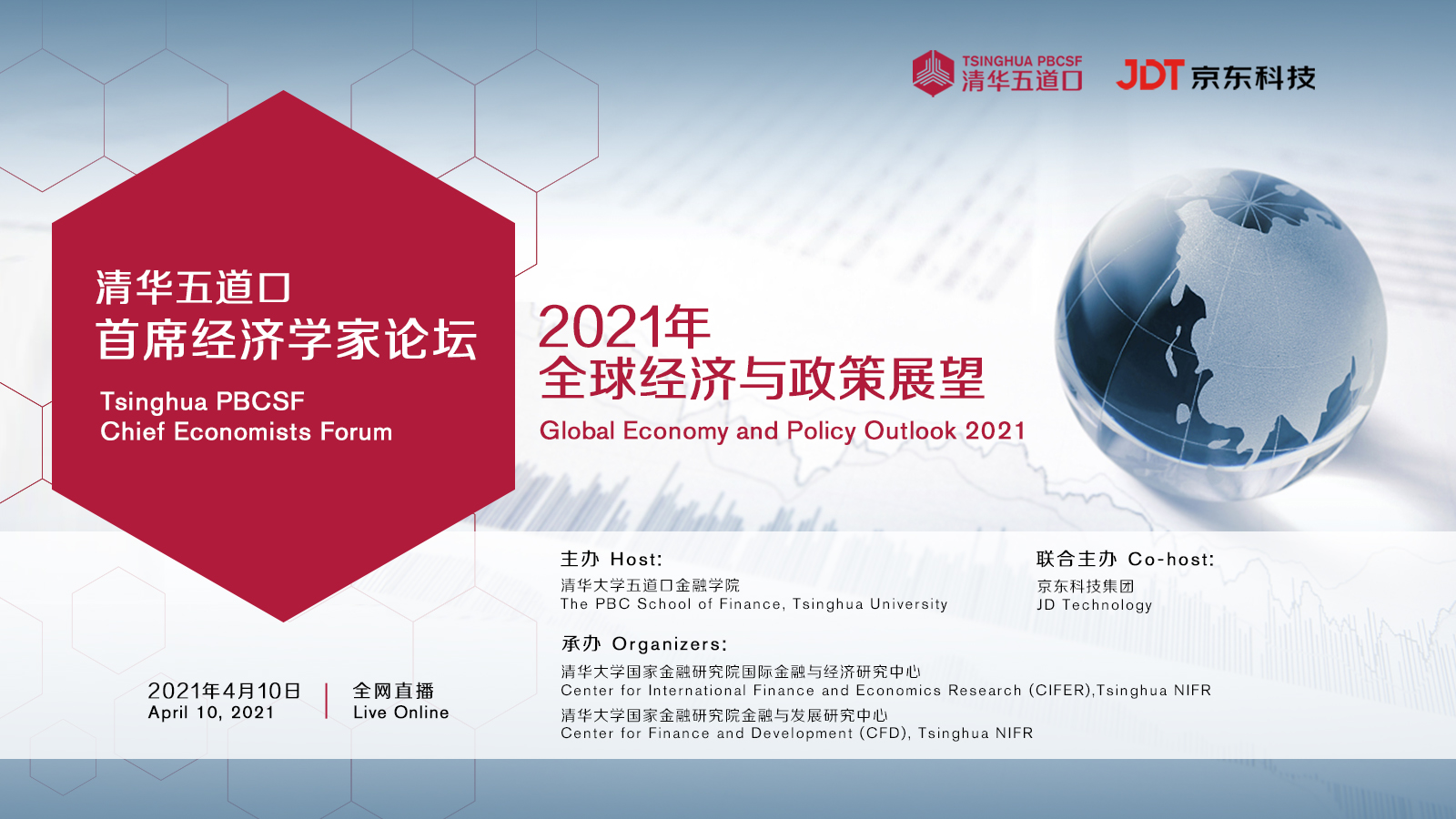
Recently, a conference was held, hosted by Tsinghua University's PBCSF (Public School of Finance), co-hosted by JD.com, and organized by the Center for International Finance and Economics Research (CIFER) and the Center for Financial and Development Research (CFD) of Tsinghua University's National Institute of Financial Research."Tsinghua University PBC School of Finance Chief Economist Forum – 2021 Global Economic and Policy Outlook"The event was broadcast live on 27 platforms across the internet, attracting attention from nearly 100 media outlets and drawing over 10 million viewers.Professor Ju Jiandong, Ziguang Chair Professor of Tsinghua University's PBC School of Finance and Director of the Center for International Economics and Finance Research (CIFER), served as the forum's chief moderator.

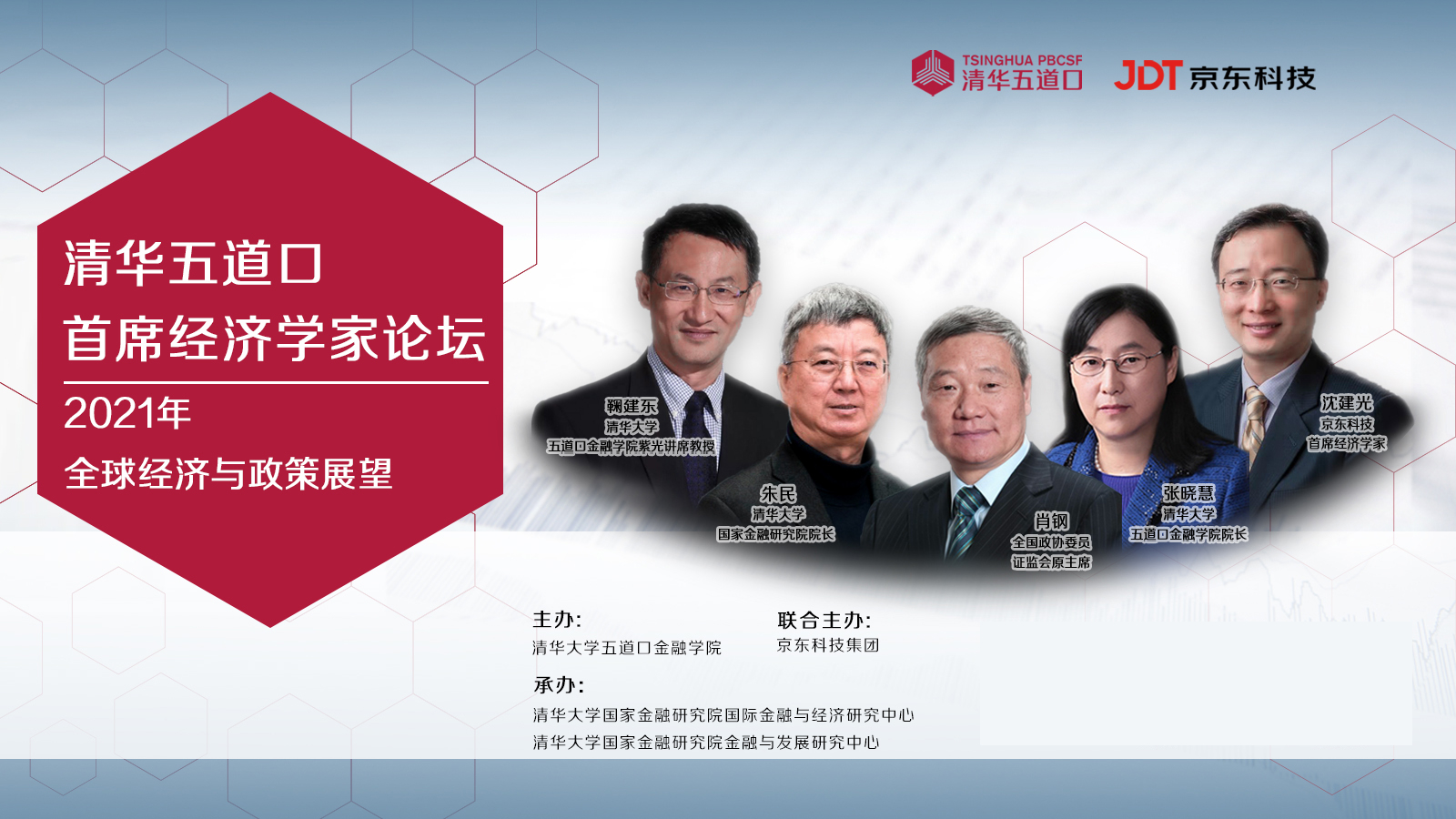
The moderator for the first roundtable discussion was Shen Jianguang, chief economist of JD Technology Group.Chief economists aroundGlobal Economic OutlookThis topic was discussed in depth, with the consensus being that the global economic recovery in 2021 will be divergent, and the upside risks to the US economy are high. However, the chief analysts held differing views on whether there will be sustained inflationary pressures and the spillover effects of rising US Treasury yields on international financial markets.

Ding Shuang
Ding Shuang, Chief Financial Officer of Standard Chartered Bank China, attended the first roundtable discussion at the "Global Economic Outlook" forum.In his speech, he mentioned that the global output gap remains relatively large, and the possibility of sustained inflation is relatively small. He believes that the Federal Reserve will ignore the temporary rise in inflation, and interest rate hikes may not be implemented until the unemployment rate drops to around 3.5% in 2023.
 Ding Shuang's speech
The following is the full text of the speech, which has not been reviewed by the speaker:
Ding Shuang: Thank you!
I am very pleased to be invited by my alma mater, Tsinghua PBC School of Finance, and I am also honored to be here with you, the chief economists and experts, to discuss the outlook for the Chinese and global economies.
To avoid repetition, I will focus more on the recent rise in US Treasury yields and whether it will continue to rise. In discussing this issue, we must start with the divergence in global economic recovery, which is becoming an increasingly common consensus, as mentioned by the experts just now.
We expect global economic growth to reach 5.7% this year, compared to -3.3% last year. This represents a difference of approximately 9 percentage points, indicating a relatively good global recovery overall. However, the pace of growth has diverged, primarily driven by two factors: the effectiveness of pandemic control and vaccination rates, and differences in policy support. Developed economies are expected to perform relatively well this year, with growth reaching 5%, compared to -5.2% last year, roughly offsetting last year's negative growth. As Haibin mentioned earlier, this growth rate is higher than that of the Middle East, Africa, and Latin America. Differences also exist among developed economies. As Jianguang mentioned, there's a difference between the US and Europe. I sometimes jokingly say that this difference might also be reflected in the performance of US and European banks; European banks' profitability significantly lagged behind US banks last year. This is mainly due to the two reasons I just mentioned: by the end of March this year, approximately 30% of the US population had received at least one dose of vaccine, while in Europe it was around 10%. Europe now aims to have 70% of adults vaccinated by mid-September, but achieving this goal now seems very difficult.
Another reason is policy. Fiscal stimulus in Europe is very limited. The Eurozone has a recovery fund of €750 billion, and it's unlikely to receive further increases, unlike the US. The €750 billion fund's disbursement may be delayed; it was originally scheduled for mid-year, but is now postponed for various reasons. After the US's €1.9 trillion fiscal stimulus, it is discussing an additional €3 trillion, which may only be implemented gradually over the next 8-10 years, and may also require tax increases to offset some of the deficit. These two differences have led us to predict US economic growth of 6.5% this year, while the Eurozone's is 3.7%. We expect the US economy to reach the level of the fourth quarter of 2019 by the second quarter of this year, while the Eurozone may not return to its 2019 Q4 GDP level until the second quarter of next year—a year's difference.
Among emerging economies, Asia has performed relatively well, with the exception of Japan. We expect Asia's economic growth to reach 7.7% this year. We must mention China, where there is also a divergence. The divergence between China and major developed economies lies in policy. As Hai Bin mentioned earlier, China's economic growth trend, looking at month-on-month growth, is likely downward, which is closely related to Chinese policy. While other countries are still recovering from the pandemic and further stimulating the economy, China's policy has already begun to withdraw, although not a sharp turn, the trend of withdrawal is quite obvious. This divergence has led to recent concerns about inflation, especially given the rapid economic rebound in the US and the potential for additional fiscal stimulus measures. Wang Qian also mentioned the temporary imbalance between supply and demand, coupled with the base effect. We expect US core inflation to reach 2.5% in the second quarter, significantly exceeding the Fed's target, triggering market concerns about whether the Fed will implement quantitative easing, reduce it, or raise interest rates earlier than expected. Whether this will happen ultimately depends on the assessment of inflation and the Fed's policy.
As mentioned earlier, concerns about inflation and predictions about the Federal Reserve's policies caused the 10-year US Treasury yield to rise rapidly by 100 basis points after August of last year, from 0.6% to 1.6% in about six months. This had a significant impact on global capital flows, including those in developed economies and especially emerging economies. Many emerging economy bond markets experienced capital outflows. To retain this capital, emerging economy government bond yields rose, with some emerging economy government bond yields rising more sharply than US Treasury yields. Regarding whether this trend will continue, I largely agree with Wang Qian's statement, and I won't repeat it. I believe that the US inflation is a temporary spike, and the base effect will gradually dissipate. On the supply side, if the economy reopens, there will be some catch-up. On the demand side, overall, there is still a significant output gap; capacity utilization has not yet been reached, and full employment has not yet been achieved. Therefore, the possibility of sustained inflation is relatively small.
In this scenario, our assessment of US monetary policy is that the Federal Reserve will ignore temporary inflationary pressures and only begin quantitative easing (QE) and tapering after substantial progress is made in inflation and employment. This tapering is likely to be considered around early 2022, when the unemployment rate has fallen from the current 6% to approximately 4.5%. As for interest rate hikes, they are likely to occur in 2023, after the unemployment rate returns to a more normal pre-pandemic level of around 3.5%. Under these circumstances, we anticipate that US Treasury yields may rise further, reaching 1.75% in the second quarter and potentially 2% by the end of the year. The main driving factor will be the new fiscal stimulus measures, specifically the $3 trillion stimulus package. This fiscal stimulus will lead to increased issuance of US Treasury bonds, pushing up yields. However, compared to the past six months, the rate and magnitude of this rise will be slower. Another point is that if yields rise more than expected, and rise very rapidly, although the Federal Reserve currently views rising yields as a reflection of a strong economy, we expect the Fed to intervene if growth is too fast. This is because it would first increase the cost of issuing US Treasury bonds, and secondly, it would increase interest rates on US mortgage loans, as housing investment is a significant driving factor. Therefore, we believe there is relatively little room for further increases in US Treasury yields.
Finally, regarding emerging market bond markets, a rise in US Treasury yields will still have an impact, but we believe the impact on the Chinese bond market will be relatively small. The main reasons are twofold: firstly, the RMB exchange rate remains relatively stable. Although the recent appreciation of the US dollar has led to a slight depreciation of the RMB against the dollar, it remains relatively stable compared to other currencies. Secondly, as mentioned earlier, the 10-year US Treasury yield has risen to 2.25%, while the current yield on Chinese government bonds is still 100 basis points higher, demonstrating both yield and exchange rate stability. Furthermore, the volatility of the Chinese bond market is significantly less correlated with the volatility of the US and other developed economies' bond markets, increasing the benefits of diversification. Investing in the Chinese market has less correlation with the volatility of other markets, increasing the effectiveness of diversification. Therefore, we expect that even with a slight rise in US Treasury yields, the Chinese bond market will still see net inflows this year, with the net inflow scale comparable to last year, slightly exceeding 1 trillion RMB.
That's all for now, thank you!
 Group photo of participants at Roundtable (I) Global Economic Outlook
2021On April 10, the "Tsinghua University PBC School of Finance Chief Economist Forum" returned online after a two-year hiatus.This forum consisted of two parts: keynote speeches and roundtable discussions. It was held online and streamed live across the entire network, ensuring a smooth exchange of ideas and perspectives. The forum invited over twenty prominent guests to gather virtually and engage in in-depth discussions on topics such as the global economic outlook, China's macroeconomic and policy outlook, money and credit in the post-pandemic era, and carbon neutrality and the macroeconomy.