December 2-3, 2022, hosted by the Center for International Finance and Economics Research (CIFER) of the National Institute of Financial Research, Tsinghua University.Academic Symposium on "2022 International Trade Disputes and the Restructuring of Globalization"The event was successfully held.Lingnan College, Sun Yat-sen UniversityAssistant ProfessorZhan ChaoqunAttendDepend onCIFERAssistant Research Fellow, Tsinghua University PBC School of Finance (Postdoctoral Fellow)Li YuankunHostTrade disputesFDIWith innovationSub-forum 3Sharing with collaborators (as shown below) titledFDI Inflows and Export Quality: Domestic Competition and Firm Internal Adjustments(FDI Inflows and Export Quality: Domestic Competition and Within-firm Adjustment) The article.
Zhan ChaoqunAssistant Professor, Lingnan College, Sun Yat-sen UniversityDistinguished Associate Research Fellow, PhD in Economics from the University of Hong Kong, specializing in international trade, mergers and acquisitions, and the Chinese economy; published papers in [Journal Name].Journal of International EconomicsHe has published academic papers in journals such as An Zijie International Trade Paper Award and received a nomination for the Aoki Masahiko Economics Paper Award. He has also presided over a National Natural Science Foundation of China (NSFC) Youth Project.

Zhan Chaoqun
Product quality is widely considered a crucial determinant of economic development. This paper investigates whether horizontal foreign direct investment (FDI) improves or deteriorates the export quality of domestic enterprises. Using changes to China's 2002 FDI regulatory catalogue as an instrumental variable (IV) for FDI penetration in China, this paper determines the causal impact and introduces a theoretical model to make the empirical work more reasonable. The paper finds that FDI inflows have a significant negative impact on the export quality of Chinese enterprises. The mechanism of this negative impact is that FDI intensifies competition in the domestic market, leading to adjustments in the product mix within enterprises and reducing their incentive to invest in the quality of new products. Specifically, although domestic companies abandon some existing products and introduce new ones, their investment in the quality of these new products decreases, while maintaining the quality of subsequent products.
Recent studies have emphasized the importance of product quality. For example, product quality upgrading is the most important form of innovation; product quality differentiation is also the most important source of firm heterogeneity. This paper aims to investigate how globalization helps firms upgrade their quality. Many studies focus on the impact of trade on firm quality upgrading, while few research the relationship between FDI and firm product quality.However, FDI is a crucial factor that cannot be ignored. Globally, many countries use policies to promote FDI: in 2001, 160 countries used such policies, three-quarters of which came from developing countries. FDI plays a significant role in capital formation. Therefore, this paper uses Chinese data to study the impact of FDI on the product upgrading of enterprises in host countries.Match the following data from 2000 to 2006 with data from companies that exported both before and after 2002.
- Panel data of industrial enterprises above designated size
- Industry-level foreign direct investment policy catalog data
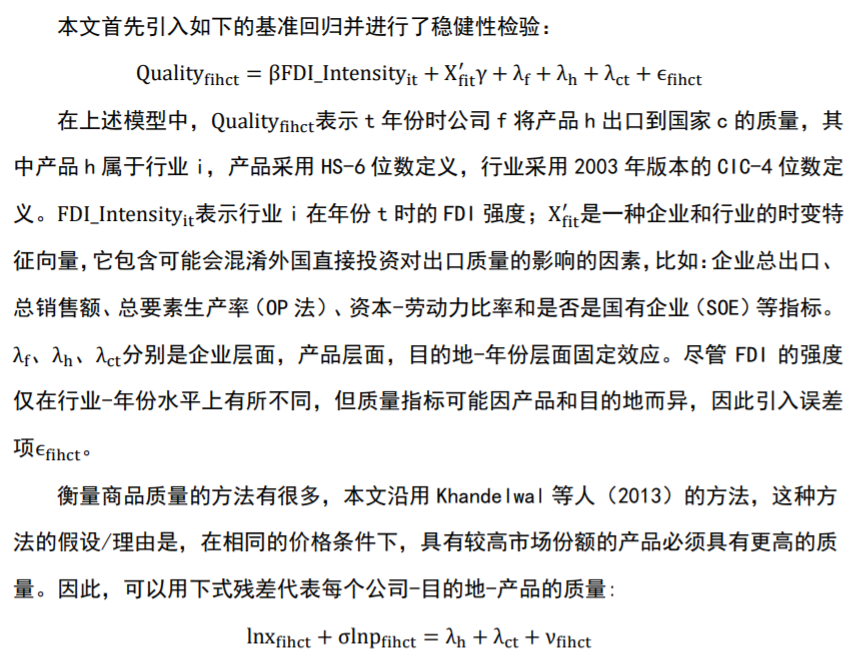
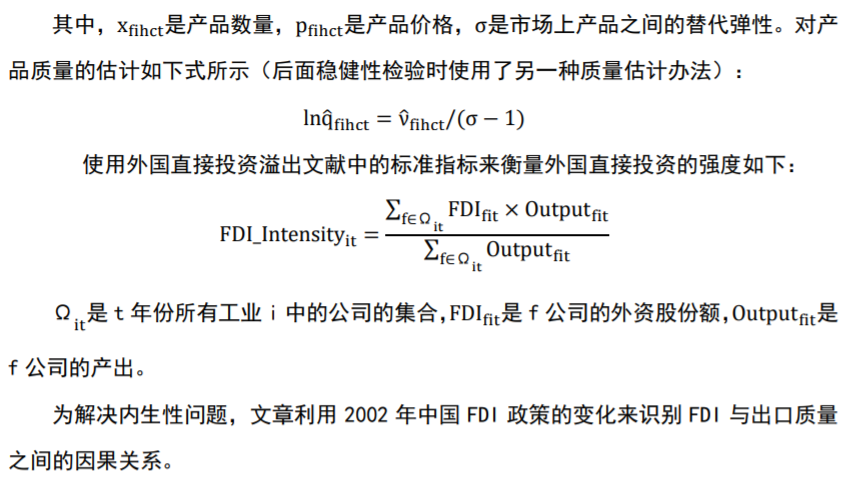
In the theoretical analysis section of the empirical results (analyzing why FDI reduces the average quality of Chinese companies' exported products): First, this paper introduces a simple static model to analyze the relationship between foreign direct investment (FDI) and the product quality of domestic enterprises. Second, this paper constructs a multi-product dynamic model to further study the various channels through which FDI affects product quality. Data is used to test the model, confirming the conclusions of the dynamic model—the impact of FDI intensifies competition in the domestic market, reduces sales and profits for Chinese companies, and thus affects the quality of both existing and new products.
FDI will lower the average quality of Chinese companies' exported products. This paper provides a theoretical framework to understand the channels through which FDI impacts the quality of Chinese firms' exports. Our empirical analysis supports the following channels and predictions. whenWhen market competition outweighs technology spillover effects, Chinese companies reduce their investment in product quality due to lower returns on investment. When the changes in foreign direct investment policy in 2002 are viewed as a shock, the study found that the impact on investment only occurred in newly launched products. Therefore, the decline in the average quality of Chinese companies' exported products is due to the lower quality of new products, while the quality of existing products remains unchanged.

Wu Jing
Professor of Business School, The Chinese University of Hong KongWu JingFirst, the main content of the article is summarized. This article mainly discusses whether horizontal foreign direct investment (FDI) has improved or damaged the quality of products in my country, and explores the underlying mechanisms. The main finding is that FDI has reduced the quality of exports from Chinese domestic enterprises, with competition as the underlying mechanism. This article is significant because FDI has played different roles at different stages of my country's development, from meeting external demand to meeting domestic demand. Studying the impact of FDI on the quality of domestic products has positive significance for national development. Professor Wu Jing further proposes the following suggestions: First, regarding the measurement of product quality: as a business manager, one is more concerned with overall product quality; could the article further discuss changes in overall product quality? Moreover, at the same price, a product with a larger market share does not necessarily have higher product quality. Second, regarding the economic application of the article's conclusions: does FDI have a heterogeneous impact on products with different technological contents? Regarding the conclusion that companies reduce the quality of new products, leading to a decrease in overall product quality, should the market share of new products in all products be considered? Finally, regarding the mechanism discussion, China's accession to the WTO also brought about the flow of domestic investment; did this also intensify market competition? Should this be included as a control variable in the discussion?
